
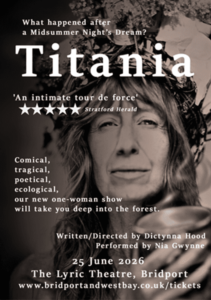
Titania at the Lyric: a Soliloquy for Our Time
An interview with the actor Nia Gwynne by Rebecca Danicic, Bard of West Dorset
Titania is a new one‑woman play by writer‑director Dictynna Hood, whose work in film and theatre has long circled questions of memory, place, and belonging. Performed by Nia Gwynne, a long‑standing member of the Royal Shakespeare Company, the piece brings Shakespeare’s fairy queen into our modern age, where forests have thinned and magic has faded. This being who once ruled the midsummer woods is forced to confront what mortal hands have made of the earth. I sat down with Nia to talk about what it took to wake Titania from her flowery bed.
I asked Nia what she thought inspired Hood to write this play, and why now. “Dictynna was spending a lot of time in Cornwall, inspired by the natural beauty of the landscape,” she explains. “So much of A Midsummer Night’s Dream is full of the natural world, and I think she used that as inspiration. She took the story of Titania as her springboard and just thought, ‘What happens to her after the play?’”
As an actor who has been immersed in Shakespeare through her extensive work with the Royal Shakespeare Company, Nia is alert to the way his comedies often end with all loose strands tied up a little too neatly. “At the end [of A Midsummer Night’s Dream], as he often does, [Shakespeare] makes sure there is a way where everyone comes back together and everyone lives happily ever after, and that’s sort of problematic in a lot of his plays. So I think it was intriguing [to ask], ‘What happens if that somehow is fractured in the end as well?’”
Gwynne finds that Titania’s immortal nature offers the right creative freedom to fracture and question old customs and forms. “She is not mortal so you can have a lot of fun with that as a writer. It means you can play or say whatever you want, because she is abiding by different rules. This play is four or five hundred years later and she is still with us because she doesn’t age the same way mortals do.” From there, questions proliferate: “What is it like to be an observer outside and see history open over the last four or five hundred years? There is what we are facing now, which is climate chaos, and Titania is a being who is utterly at one with nature, so how does she process and feel about what is happening to the natural world?”
Hood wrote Titania specifically for Gwynne, so I am curious about where actor and character overlap. I ask Nia when it is that she feels closest to Titania in the play. “There is a very strong narrative in the piece about parenthood, and I am a parent, so I suppose that chimes with me most clearly: what it is to be a parent, legacy, the experience of loving a child. There is also talk of loss, and a loss of that love […] so her motherhood really chimes with me.
“In all other ways,” she laughs, “she’s nothing like me – that is what is nice about acting! She is mercurial, she’s naughty, she’s angry, she’s frightened, she’s bemused, she’s lost at times, and [one’s] job as an actor is […] to take a part of yourself and amplify it for whatever part you are playing.” As Nia describes reaching beyond herself to these amplifications, it’s easy to imagine Titania’s spell working on us too, as a conduit to the parts of ourselves – the fears, anxieties and bewilderment; the playfulness and righteous rage – that lie beneath the surface of our modern sensibility.
Curious about how all this finds its way into the body, I ask Nia how she came upon Titania’s physicality – what helped her to embody the fairy queen? She recalls how Hood “talked about the way animals have a quality of attention and a quality of awareness,” in their perception of their environment and potential dangers around them. Actor and director worked together in rehearsal to “try to foster that in the way that you hold your attention or hold your gaze.”
Titania’s animalistic sensitivity extends to her attunement to the shared energy in the room and her connection to ‘these mortals on the ground’ where she has landed: “Titania is not really a one‑woman show, as it is completely dependent on the audience,” Nia explains. “The whole thing would actually be a soliloquy in a Shakespeare play, because you are speaking to the audience rather than just coming out of the action.” I wondered if this made rehearsals a challenge. “Even early on,” she recalls, “we had two people in to listen to the reading, and it changed me completely. It was easy to plot and block through moves and talk about what the character wants and how she is feeling, but with a piece of work like this, it is not until you get an audience that it really starts to have a sort of buoyancy and flow.”
I wonder if this form of the full-scale soliloquy has opened up new avenues in her craft that she wishes to pursue. “I’ve never done anything that is wholly direct address before. It’s shown me a different way of playing. Would I do it again? I don’t know, but there is a joy of being the storyteller and holding that responsibility. When it’s going well, you can feel it – you can feel the exchange of energy with the audience.”
Indeed, whilst there is no formal audience participation, a conversation between spectator and Titania, the mortal and the immortal, seems to sit at the core of this production. “She is an extraordinary character – you’d want to hang out with her… for a bit!” laughs Nia. “If there was a party at Titania’s, you’d probably want to go.” I ask what she would say to Titania if she met her at a party. “I’d ask her: does she think the planet can fix itself? She has seen a lot of destruction and loss; does she have faith that it can make itself better?”
Titania won’t offer us tidy answers, but the queen of the fairies is sure to draw us in, charm and beguile us, ask us hard questions, and leave us with new thoughts, new hope, and more than a touch of midsummer magic.
Titania plays the Lyric Theatre, Bridport, for one night only on Thursday 25 June at 7:30pm. Tickets are £12 and available at Bridport TIC: www.bridportandwestbay.co.uk
