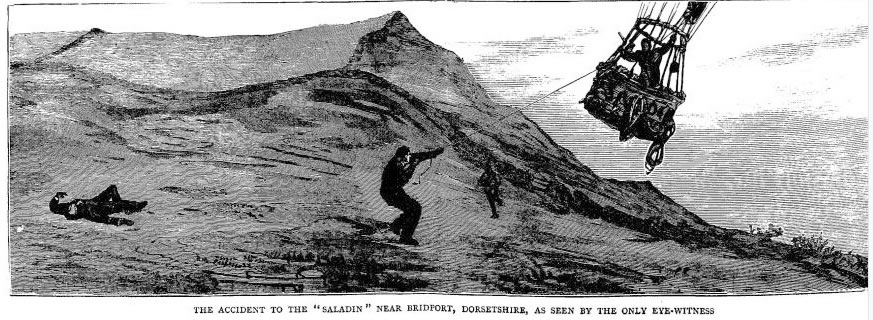
Further to the FATAL BALLOON DISASTER. The Saladin, a hot air ballon for taking meteorological measurements, piloted by Walter Powell a well known member of parliament and amateur magic lanternist crash landed near Eype on 10th December 1881. Spilling out the other crew members, it took off again leaving the helpless aeronaut drifting seaward off into the noospheric yonder and apparently provoked reports of UFO's across the country.
These reports of mysterious "lights in the sky" were picked up and read with interest by Charles Fort [Complete Books pp.461-2], who in New Lands devoted a full page to sightings of mysterious "lights in the sky" reported in the days that followed, many of which moved about in a manner quite unlike any balloon:
The extraordinary circumstance is that reports came in upon a luminous object that was seen in the sky at the time that this balloon disappeared. In the London Times, it is said that a luminous object had been seen, evening of the 13th, moving in various directions in the sky near Cherbourg. It is said that upon the night of the 16th three customhouse guards, at Laredo, Spain, had seen something like a balloon in the sky, and had climbed a mountain in order to see it better, but that it had shot out sparks, and had disappeared – and had been reported from Bilbao, Spain, the next day. In the Morning Post, it is said that this luminous display was the chief feature; that it was this sparkling that had made the object visible. In the Standard, December 16, is an account of something that was seen in the sky, five o'clock in the morning of December 15, by Capt. McBain, of the steamship Countess of Aberdeen, off the coast of Scotland, 25 miles from Montrose. Through glasses, the object seemed to be a light attached to something thought to be the car of a balloon, increasing and decreasing in size – a large light – "as large as the light at Girdleness" [a lighthouse]. It moved in a opposite direction to that of the wind, though possibly with wind of an upper stratum. It was visible half an hour, and when it finally disappeared, was moving toward Bervie, a town on the Scottish coast about 12 miles north of Montrose. In the Morning Post it is said that the explanation is simple: that someone in Monfrieth, 8 miles from Dundee, had, late in the evening of the 15th, sent up a fire-balloon, "which had been carried along the coast by a gentle breeze, and, after burning all night, extinguished and collapsed off Montrose, early on Thursday morning (16th)." This story of a balloon that wafted to Montrose, and that was evidently traced until it collapsed near Montrose, does not so simply explain an object that was seen 25 miles from Montrose. In the Standard, December 19, it is said that two bright lights were seen over Dartmouth Harbor, upon the 11th.
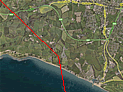
See full story and a map of the sightings here http://blogs.forteana.org/node/117
The New York Times [24 January 1883], reported the discovery of what appeared to be the remnants of a large balloon at Sierra del Pedroza, in the Asturias in Northern Spain. "a few fragments and shreds of cloth" Of Powell, however, there was no sign.
"The wreck of the balloon discovered in the Spanish mountains," concluded the NYT,
Read the full story of the Saladin here…