A ceremony granting of the civic honour of freedom by the town of Bridport to THE RIFLES takes place on on Saturday 26th March 2011 at a service in St Mary’s church followed by a ceremony and sounding retreat on south street.
Brigadier Toomey of The Rifles said
“The Rifles were absolutely delighted when they learned that the Town of Bridport had agreed to extend its Freedom which had originally been granted to the Devonshire and Dorset Regiment in 1967. While The Rifles take recruits from across much of England, they are very keen to retain their close connections with their places of origin – the counties, cities and towns from where their soldiers come. The Regiment cherishes its close relationship with the people of Bridport and is enormously honoured to be able to accept the Freedom.”
A number of traditions mark the Rifles out when they are on parade. Harking back to their origins as fast-moving ‘light’ infantry, they march noticeably faster than other Army units and carry nothing which would reduce their speed. Whereas normal ‘heavy’ infantry units carry Colours (large unit flags) on parade, officers and soldiers of The Rifles carry a badge on their belts which represents the Colours. Bulky drums, used to signal to troops in battle, are replaced by more practical bugles. Finally, rather than scarlet uniforms, The Rifles wear green.”
THE PROCESSION
10.30 am The Civic Procession will move from the Council Offices to St Mary’s Church via Downes Street and South Street
THE SERVICE IN ST MARY’S CHURCH
11.00 am – 11.45 am
THE FREEDOM CEREMONY
- 12.15 pm The Mayor Geoffrey Ackerman and Brigadier Toomey arrive at the dais in South Street.
- The Mayor will address the Parade and read the Freedom Scroll
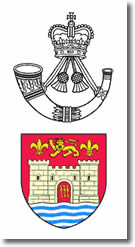
- The Mayor will then hand the Freedom Scroll to Brigadier ToomeyBrigadier Toomey will respond after which he will present the Mayor with a Silver Bugle from The Rifles to commemorate the granting of the Freedom. The Bugle is the emblem of The Rifles and is incorporated into their cap badge
SOUNDING RETREAT (MUSICAL AND MARCHING DISPLAY)
- 12.30 pm By the Salamanca Band and Bugles
- 12.45 pm Sounding Retreat ends with the Salute taken by the Mayo
Sounding Retreat
The ceremony of Sounding or Beating Retreat has its origin as far back as the 16th Century when it was called Watch Setting. It is referred to in “The Rules of Ordynnances for Warre” of 1544 where it is described as the occasion when the Drum Major of the Regiment had to signal, by beating his drum, that the soldiers of the Night Watch should report for duty.
In the 17th and 18th Centuries there were few permanent barracks and it was the custom to billet soldiers in taverns or the houses of the local population. At the end of the day’s activities the Duty Officer, accompanied by a drummer or bugler, would patrol through the area to warn the soldiers to assemble in the town square for roll-call before they retired to their billets. At the parade the regimental flag would be lowered to the accompaniment of the Retreat call, formally signalling the start of the Night Watch. After that “the sentinels are to challenge till the break of day when Reveille is sounded.” Over the years the Retreat was embellished to become a full ceremonial display, but it still marks the end of the day’s activities.
Within Dorset, the lineage of the
County Infantry Regiment is as follows:
The Dorset Regiment
(39th and 54th Foot) (1702 – 1958)
The 39th Foot was raised in 1702 and the 54th Foot in 1755. A Battle Honour unique in the British Army, Plassey (1757) was won by the 39th under Lord Clive in India, and with it the proud motto ‘Primus in Indis’. In 1801, the 54th Foot also gained a unique battle honour, Marabout, in Egypt, against Napoleon’s Army, after which they were sent to Gibraltar, in time to put down a mutiny and so assist in saving the life of the Duke of Kent, Queen Victoria’s father, who was Governor of the Fortress. Since then the House of Kent has always been associated with the Regiment through the Colonels-in-Chief. The present Duke of Kent is Royal Colonel of 1 RIFLES.
The 39th & 54th amalgamated in 1881 under the Cardwell Reforms, to become 1st & 2nd Battalions of the Dorset Regiment. During the First World War, 10 battalions of the Dorsets served with great distinction in France and Flanders, the Gallipoli Peninsula and the Middle East.
In the Second World War, the 1st Dorsets served in 231 (Malta) Brigade, taking part in assault landings on Sicily, Italy and at Normandy (D Day) while the 4th and 5th (Territorial) Battalions, which formed part of the 43rd Wessex Division (whose memorial stands on the hill at Mere) were fully involved in the advance into Germany, particularly distinguishing themselves at Arnhem. The 2nd Battalion, meanwhile, having taken part in the withdrawal from Dunkirk, spent most of the War in the Far East, serving in Burma, including the famous hard-fought victory at Kohima.
The Devonshire and Dorset Regiment
(11th , 39th and 54th Foot) (1958 – 2007)
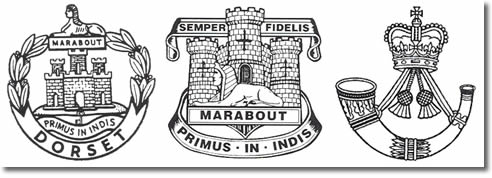
The amalgamation of these two famous old County Regiments took place in Minden, West Germany in 1958 and the presentation of its first Stand of Colours by the then Colonel-in-Chief, HRH The Duchess of Kent in Plymouth in 1962. The new cap badge embodied the Castle of Exeter and ‘Semper Fidelis’ from the Devons, and ‘Primus in Indis’ and the Egyptian Sphinx with ‘Marabout’ from the Dorsets.
During the 1st Battalion’s 49 years of existence, it served in Germany, Cyprus, British Guiana, Libya, Malta, British Honduras, Bosnia, Northern Ireland and Iraq. Most of this service, including ten tours to Northern Ireland, was on active service of one kind or another.
The Devonshire and Dorset Regimental Chapel is in Exeter Cathedral and the Dorset Regiment Chapel is in Sherborne Abbey.
The Regiment’s Museum is at The Keep in Dorchester.
THE RIFLES (2007- )
The Rifles was formed on 1st February 2007 from an amalgamation of four famous regiments: The Devon and Dorsets, the Royal Gloucestershire Berkshire and Wiltshires, the Light Infantry and the Royal Green Jackets. The new Regiment consists of 5 Regular and 2 Territorial Battalions:
- 1st Battalion is based at Chepstow and is currently on operations in Afghanistan.
- 2nd Battalion is based in Ballykinler, Northern Ireland.
- 3rd Battalion is based in Edinburgh.
- 4th Battalion is based in Bulford near Salisbury. A company is currently in the Falkland Islands
- 5th Battalion based in Paderborn, Germany and is due to deploy to Afghanistan in September.
- 6th (Territorial) Battalion has its Headquarters in Exeter and bases throughout the West Country. A number of the Battalion’s soldiers are currently serving in Afghanistan, including some with 1 RIFLES.
- 7th (Territorial) Battalion has its Headquarters in Reading and bases throughout the Home Counties. It also has a number of soldiers serving in Afghanistan.
Among the many battle honours earned by the forming regiments is “Salamanca” a battle in 1812 during the Peninsular War at which all the regiments fought and which is now the Regimental Day, celebrated annually on 22nd July.