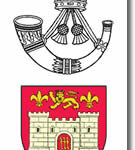
The Rifles Regiment were given the Freedom of the Town of Bridport in March 2011. Images by Greg Hayball. Click on the thumbnails for a larger image.
{yoogallery src=[/images/stories/rifles_freedom_bridport/] height=[200]}
Brigadier Toomey presents a Silver Bugle, emblem of The Rifles, to Mayor Geoff Ackerman. H.M. Lord Lieutenant of Dorset, Mrs. Anthony Pitt-Rivers (in red jacket) also present.
Within Dorset, the lineage of the
County Infantry Regiment is as follows:
The Dorset Regiment
(39th and 54th Foot) (1702 – 1958)
The 39th Foot was raised in 1702 and the 54th Foot in 1755.· A Battle Honour unique in the British Army, Plassey (1757) was won by the 39th under Lord Clive in India, and with it the proud motto ‘Primus in Indis’.· In 1801, the 54th Foot also gained a unique battle honour, Marabout, in Egypt, against Napoleon’s Army, after which they were sent to Gibraltar, in time to put down a mutiny and so assist in saving the life of the Duke of Kent, Queen Victoria’s father, who was Governor of the Fortress.· Since then the House of Kent has always been associated with the Regiment through the Colonels-in-Chief. The present Duke of Kent is Royal Colonel of 1 RIFLES.
The 39th & 54th amalgamated in 1881 under the Cardwell Reforms, to become 1st & 2nd Battalions of the Dorset Regiment. During the First World War, 10 battalions of the Dorsets served with great distinction in France and Flanders, the Gallipoli Peninsula and the Middle East.
In the Second World War, the 1st Dorsets served in 231 (Malta) Brigade, taking part in assault landings on Sicily, Italy and at Normandy (D Day) while the 4th and 5th (Territorial) Battalions, which formed part of the 43rd Wessex Division (whose memorial stands on the hill at Mere) were fully involved in the advance into Germany, particularly distinguishing themselves at Arnhem.· The 2nd Battalion, meanwhile, having taken part in the withdrawal from Dunkirk, spent most of the War in the Far East, serving in Burma, including the famous hard-fought victory at Kohima.
The Devonshire and Dorset Regiment
(11th , 39th and 54th Foot) (1958 – 2007)
The amalgamation of these two famous old County Regiments took place in Minden, West Germany in 1958 and the presentation of its first Stand of Colours by the then Colonel-in-Chief, HRH The Duchess of Kent in Plymouth in 1962.· The new cap badge embodied the Castle of Exeter and ‘Semper Fidelis’ from the Devons, and ‘Primus in Indis’ and the Egyptian Sphinx with ‘Marabout’ from the Dorsets.
During the 1st Battalion’s 49 years of existence, it served in Germany, Cyprus, British Guiana, Libya, Malta, British Honduras, Bosnia, Northern Ireland and Iraq.· Most of this service, including ten tours to Northern Ireland, was on active service of one kind or another.
The Devonshire and Dorset Regimental Chapel is in Exeter Cathedral and the Dorset Regiment Chapel is in Sherborne Abbey.
The Regiment’s Museum is at The Keep in Dorchester.
THE RIFLES (2007- )
The Rifles was formed on 1st February 2007 from an amalgamation of four famous regiments: The Devon and Dorsets, the Royal Gloucestershire Berkshire and Wiltshires, the Light Infantry and the Royal Green Jackets. The new Regiment consists of 5 Regular and 2 Territorial Battalions:
- 1st Battalion is based at Chepstow and is currently on operations in Afghanistan.
- 2nd Battalion is based in Ballykinler, Northern Ireland.
- 3rd Battalion is based in Edinburgh.
- 4th Battalion is based in Bulford near Salisbury. A company is currently in the Falkland Islands
- 5th Battalion based in Paderborn, Germany and is due to deploy to Afghanistan in September.
- 6th (Territorial) Battalion has its Headquarters in Exeter and bases throughout the West Country. A number of the Battalion’s soldiers are currently serving in Afghanistan, including some with 1 RIFLES.
- 7th (Territorial) Battalion has its Headquarters in Reading and bases throughout the Home Counties. It also has a number of soldiers serving in Afghanistan.
Among the many battle honours earned by the forming regiments is “Salamanca” a battle in 1812 during the Peninsular War at which all the regiments fought and which is now the Regimental Day, celebrated annually on 22nd July.