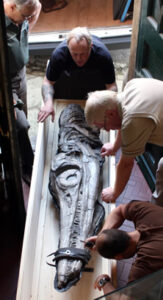
The most famous fossilist’s most famous fossil is the new arrival at Lyme Regis Museum. The world’s first discovery of a complete Ichthyosaur was made by Mary Anning and her brother Joseph in 1811 in the 205 million year old Jurassic Blue Lias from cliffs nearby. Now after 200 years the remaining gigantic skull has returned to the site of Mary’s childhood home, on loan from The Natural History Museum in London
Soon after it was found the Anning family sold the ichthyosaur to Henry Hoste Henley of Colway Manor in Lyme for £23. From there it was sent to London, probably by sea, where it was exhibited at William Bullock’s Museum of Natural Curiosities. In 1819 the specimen was purchased by the British Museum making its way to the Natural History Museum where it is usually displayed alongside a selection of other marine reptile fossils. The skull’s return to Lyme Regis for the first time in 200 years was delivered by Natural History Museum fossil staff Dr Martin Munt and Dr Tim Ewin.
Carrying the heavy, two-metre-long specimen up the museum’s spiral staircase to the geology gallery proved to be too difficult a manoeuvre, so space was made for it in the ground floor gallery where it will be on display until the end of September.
A grant from Natural England and financial support from the Natural History Museum has made the loan possible. Dr Martin Munt said ‘It has been a privilege to help Lyme Regis Museum achieve their dream of bringing home this iconic fossil specimen to mark the 200th anniversary of its discovery. We have been planning this for over a year and it has involved working closely with my colleagues throughout the Museum including those in the Museum’s Paleontology Conservation Unit.’
One of the largest species of ichthyosaur, this ichthyosaur temnodontosaurus platydon (meaning ‘cutting tooth lizard’)